

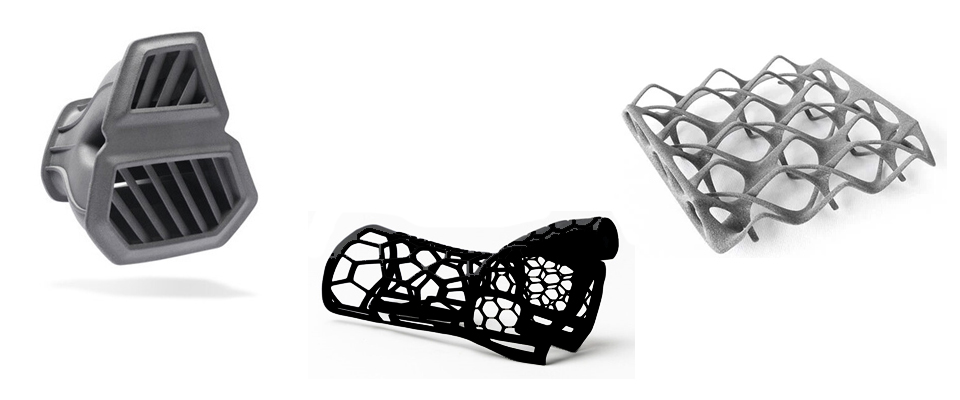
HP's Multi Jet Fusion (MJF) technology is an advanced form of powder bed 3D printing.
In essence, it works like this:
A thin layer of powder (e.g., Nylon PA12) is spread onto the build platform.
Inkjet printheads (similar to those in 2D printers) selectively deposit fusing and detailing agents onto the powder.
A heating lamp passes over, instantly fusing only the areas treated with the fusing agent.
The process repeats layer by layer.
This allows for the creation of complex, rapid, and functional parts with excellent mechanical properties, minimizing waste thanks to the reuse of unfused powder. Unlike laser-based technology, which can be identified by the use of white materials, this technology produces isotropic parts with mechanical properties that are uniform in all directions.
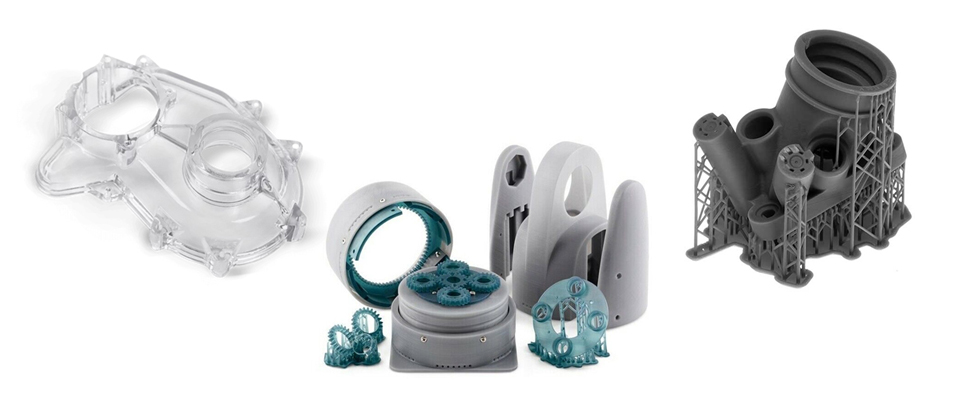
Stereolithography (SLA) is one of the oldest and most precise 3D printing technologies.
In short, it works like this:
A tank contains a liquid photopolymer resin sensitive to UV light.
A UV laser beam selectively strikes the surface of the resin.
Where the laser hits, the resin instantly solidifies (polymerizes), creating a single layer of the model.
The build platform lowers by a small step, and the laser solidifies the next layer.
The process repeats layer by layer until the object is complete.
Key advantages: SLA is renowned for its extreme precision, exceptionally smooth surface finish, and the ability to create incredibly fine details.
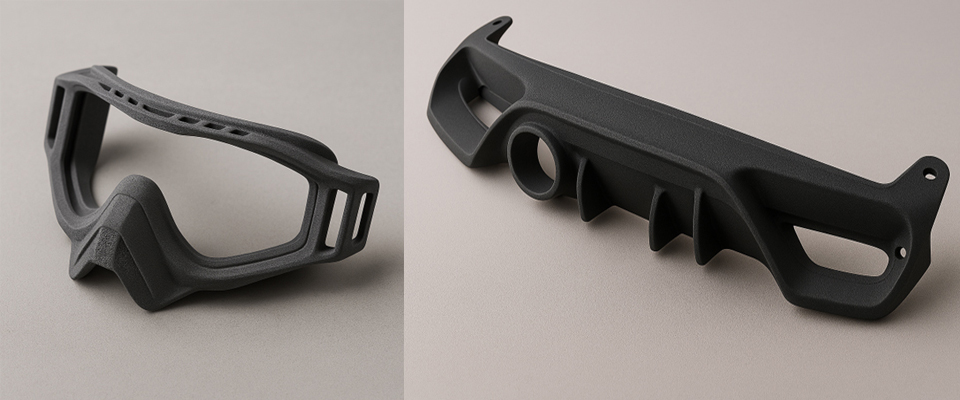
Selective Laser Sintering (SLS) is a 3D printing technology that uses a laser to melt and fuse a polymer powder (commonly Nylon) layer by layer within a bed of material.
The advantages are the ability to have white components for subsequent color dyeing and greater thicknesses compared to MultiJet Fusion technology, thanks to reduced thermal effects
A new approach to the world of 3D printing.